Thursday, March 31, 2011

Things To Consider Before Buying A Tree


1. What size and type of tree am I looking for?

Shade Tree:
40-60' x 40-60'
Bur Oak, Hackberry, Siouxland Poplar

Ornamental:
10-30' x 10-30'
Japanese Tree Lilac, Crabapple, Amur Chokecherry

Boulevard
20-40' x 20-40'
Maple, Ash, Linden

Evergreen
All year interest!
Pine, Spruce, Arborvitae

Fruit Trees
10-15' x 10-15'
Apple, Pear, Cherry, etc.

2. What if I have mostly shade?

Trees for wooded or shaded areas: Pagoda Dogwood, Eastern Redbud, Ash, or Hemlock.

3. Is it a very wet or very dry area?

Trees for wet areas: Swamp White Oak, Pagoda Dogwood, Willow, or River Birch.

Trees for dry area: Green Ash, Amur Maple, Theves Poplar, or Pin Oak.

4. Any obstacles in the way of tree growth?

Consider power lines, house, other trees, neighbors property line, fence line, etc.

5. Fall color, fruit, flowering?

Trees for fall color: Red Maple, Sugar Maple, Honey Locust, Pagoda Dogwood, Red Oak.

Trees with ornamental fruit: Serviceberry, Hawthorn, Crabappel, Mountain Ash.

Trees with ornamental flowers: Catalpa, Newport Plum, Eastern Redbud, Amur Chokecherry.

Tree Planting Checklist

  1. Long handled digging shovel
  2. Root stimulator
  3. Peat Moss
  4. Mulch
  5. Hose for watering
  6. Staking Kit for potted trees
  7. Tree wrap for fall

Handling

When moving trees and shrubs, handle the plant by the container or root ball. Never lift plants by the trunk or branches. Never drag plants by the trunk or branches. Do not drop plants.

Wednesday, March 30, 2011

Fun Events For The Whole Family!!


APRIL

“Grow It Right!” Perennial Mini-Seminars ~ Planting Strawberries - Saturday, April 2nd Learn

everything you need to know about planting strawberries. Informal presentations at 10am and 2pm in the Perennial Courtyard. Free!


Learn To Plant A Tree ~ Saturday, April 9th Learn the proper way to plant trees for a long, healthy life. This free demonstration will be held in the Nursery at 11am and 1pm.


“Grow It Right!” Perennial Mini-Seminars ~ Planting Asparagus - Saturday, April 9th ~ Learn

everything you need to know about planting asparagus. Informal presentations at 10am and 2pm in the Perennial Courtyard. Free!


Butterfly Container Garden Seminar ~ Saturday, April 9th, 10:30-12noon You can attract butterflies to your garden, even if you do not have a large backyard. Local landscape designer, Michael Larkin, will show how to create a butterfly container garden (for a yard or patio), with plants that attract all stages of life from larva to adult butterflies. Pre-registration and payment required. Fee: $5.00


Herbal Luncheon ~ Thursday, April 7th, 11am Our chef will prepare a delicious lunch using different varieties of herbs. Come hungry! Recipes and handouts will be available. Each participant will receive an herb plant. Pre-registration and payment required. Fee: $15.00


Children’s Homeschool Class: “Easter Egg Critters” ~ Wednesday, April 13th, 10-11am In this class, we

will make fun Easter egg critters. Please wear old clothes. Ages 5 and up. Pre-registration

required. Register at Ashcombe or online at hahaofpa.org. Fee: $5.00


All About Herbs Series, Class I - Thursday, April 14th This is the first class in a series of four. Get to know some essential herbs and learn how to grow and use them. Discussion for this class include: culinary, craft and ornamental uses of herbs; planting the 10 most popular herbs; introduction of some special favorites. We will learn as we go -- keep in mind that failure can be as educational as success! Pre-registration and payment required. 6pm. Fee: $5.00


Planting A Culinary Herbal Strawberry Jar ~ Saturday, April 16th, 10am Bring your own jar or

purchase one from us - soil is free. Herbs must be purchased at Ashcombe. 10am.

Pre-registration required.


“Grow It Right!” Perennial Mini-Seminars ~ Dividing Perennials ~ Saturday, April 16th Learn

everything you need to know about dividing perennials. Informal presentations at 10am and 2pm in the Perennial Courtyard. Free!


Children’s Class: “Plant An Herb Garden” ~ Saturday, April 16th, 9-10am In this class, each child will

select herbs, plant their container, then make decorative garden markers for the plants. Please wear old clothes. Ages 5 and up. Pre-registration required. Fee: $8.00

Thursday, March 3, 2011

SPRING OPEN HOUSE IS NEAR!

Saturday, March 19th & Saturday, March 26th


SATURDAY, MARCH 19th

How Not To Mess Up Your Landscape with George Weigel ~ Saturday, March 19th, 10am George Weigel will present this program that takes a fun look at some of the common foul-ups that your average person makes in the landscape. The point is to show the right way to care for the yard by looking at the wrong way. About half deals with design and half with maintenance. Includes handouts on “George’s Top 10 Gardening Foul-Ups” and “George’s Top 10 Tips for Better Gardens.” Pre-registration and payment required. Fee: $5.00


Let’s Get Ready For Spring! ~ Saturday, March 19th, 1-2:30pm Horticulturist and landscape designer, Michael Larkin will help you get your landscape ready for spring. Learn how to clean and sharpen your tools, when and how to properly fertilize your plants, how to successfully transplant and correctly plant your trees and shrubs, how to increase the size of your garden

by dividing your perennials and seasonal pruning tips to keep your plants blooming. Bring your questions. Pre-registration and payment are required. Fee: $5.00


“Grow It Right!” Perennial Mini-Seminars ~ Cutting Perennial Grasses ~ Saturday, March 19th Learn everything you need to know about cutting back perennial grasses. Informal presentations at 10am and 2pm in the

Perennial Courtyard. Free!


Children’s Garden Craft - Plant A Pizza Garden - children can plant a pizza garden to take along home. 10am-3pm. Free!


SATURDAY, MARCH 26th

Cutting Edge Plants To Try In Your 2011 Gardens with George Weigel ~ Saturday, March 26th, 10am Are you still planting the same old bug-prone, boring plants year after year? George will help you to get out of your rut and try some of the latest, greatest newcomers that are light years ahead of yesteryear’s plain-Jane shrubs and flowers. This program takes a look both at some of the best plants debuting in 2011 as well as some super recent introductions. Pre-registration and payment required. Fee: $5.00


“Grow It Right!” Perennial Mini-Seminars ~ Pruning Evergreens ~ Saturday, March 26th Learn everything you need to know about pruning evergreens. Informal

presentations at 10am and 2pm in the Perennial

Courtyard. Free!


Plant Your Own Pansy Strawberry Jar 10am-2pm Bring in your own jar or purchase one from us. Soil is free. Must purchase pansies at Ashcombe.


Children’s Garden Craft - Plant A Cat Garden - children can plant a cat garden to take along home. 10am-3pm. Free!


Wednesday, February 23, 2011

Getting Seeds Started In Your Garden

Naturally gardeners want to be timely in planting for the summer harvest and there are things one can do to be on schedule. Besides making a list of things you want in your garden, you will need to know how much space each one take. Plants like carrots and beets make most of their growth underground while summer squash can take a couple of feet for one plant.

If you’re starting from seed the spacing requirements likely will be found on the instructions on the back of the packet. A good thing to do would be to list all the things you want to grow and then in the column next to it put amounts desired and a column space in rows, row width,& planting dates. Next look on the seed packet to see how long it takes to grow a plant to transplant date. You will then be ready to sow your seeds.

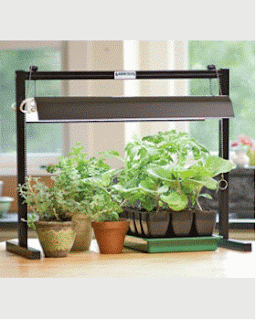
To make the job easier and grow a sturdier plant the system above can accomplish this for you. Pictured on the left above is heat mat that will hold the germinating flat and on the right a light set up that will keep your plants growing with out stretching. Most plants respond to bottom heat to germinate at soil temps of about 70 degrees. In your window or basement it may not be that temperature consistently, or you may run your home cooler than that. Once the plants are germinated it is important to get them into good light so they don't stretch. The light should be about 8 to 10 inches above the plants for best results.


Water sparingly but don't let the seedlings dry out, and once the seedlings are up keep them just slightly moist so the roots will go down for moisture. Once established the water can be reduced and temperatures cooled down to keep the plants sturdy and growing.


Bulk Seeds Heirloom Seeds Unusual seeds
You may be an organic garden and want to use organic seeds. They are available in the Burpee selection of our seed dept. Some to-go-withs are shown below for early gardeners.


Red, Yellow & White Sets Jiffy pots and other pots Shallots and garlic
With seven seed companies providing seeds, one should be able to find just what they need but if something is missing ask Greg and he will try to get it for you. Gardening vegetables was our forte about fifty years ago and we are glad to share any ideas or information you may need to be successful in your garden. And if you don't have time to grow your own plants our greenhouse will be filled with plants in April May and June to make your work easier.


THINK SPRING
Visit our Springtime Greenhouse


Tuesday, February 15, 2011

SEEDS ARE HERE!!


Check out our great selection of seeds from:


Lake Valley


P.L. Rohrer


Botanical Interests


Thompson Morgan


Livingston


Burpee


Seeds of Choice (organic)


Old Seeds


Many unusual and hard to find varieties available!


Start Right End Right

Light is the life of your plants and can either

make you successful or not. An investment in

gro-lights is truly one of the best investments

you’ll make as a start from seed grower. Along

a heat mat your rate of success will improve

greatly. At Ashcombe for more than forty years

we have been starting seeds under lights with

great success.

See our web page for more info. on growing

plants from seeds. www.ashcombe.com


Wednesday, January 12, 2011

Fill Your Winter With Color!


Few indoor flowering plants offer the charm of the beautiful, delicate African Violet. With a little bit of care and patience, they will reward you with unsurpassed beauty!


The African Violet (saintpaulia) has become the most popular member of the Gesnariad family because of its ease of culture, continuous flowering habit, variety of blossom forms, range of colors and leaf patterns.


If there is any magic formula for culture, it is a faithfully followed program of care. Watering, fertilizing, and repotting must be done with regularity and promptness if beautiful flowering plants are desired year round. “Hit-or-miss” attention will give only mediocre results.


LIGHT: Protection from the hot rays of the sun must be given, in spring, summer and fall, while during the dark days of January and February direct mild winter sunshine will promote flowering. To find the best place in the house for correct lighting, place plants in various windows and observe results. They will soon be evident. For symmetrical foliage, window grown plants need to be turned regularly so that the entire plant will get equal amounts of light.


ARTIFICIAL LIGHT: Artificial light is a satisfactory way to grow African violets for they receive evenly balanced illumination. Lights should be placed approximately 10-14 inches over the plant table and kept on from 12-14 hours per day.


WATER: Check soil daily and water if soil feels slightly dry to the touch. Always use warm or room temperature water, never cold. They will grow best if soil is kept slightly moist at all times. They do not like soggy soil and shouldn’t be left standing in water. Water from top or bottom, but from top - water under the leaves, never over.


SOIL: As a rule, these plants do best in soils which are loose in texture, porous and well drained, with a high percentage or organic matter. Because of their fine hair roots they need a substance that can be easily penetrated. There are several good commercial mixes especially made for saintpaulias.


TEMPERATURE AND HUMIDITY: Best temperatures range from 65 to 75°F. with 50 to 60% relative humidity. They can endure higher or lower temperatures but they will not prosper if the air is excessively dry. If the temperature is too low, growth slows down, flowers will be sparse and of poor quality and the foliage will curl down around the rim of the pot instead of lying flat and neat. Air that is too hot and dry can cause the buds to fall off or the blossoms to drop soon after opening.


Maintaining adequate humidity during winter without the aid of a humidifier is difficult. Otherwise, grouping the plants close together, placing them on a surface of moist pebbles in shallow tray, placing open containers of water among them will heighten the humidity.


FERTILIZING: It is better to feed very small amounts of plant food each time the plant is watered. Use a complete water-soluable fertilizer recommended for saintpaulias and read the manufacturer’s instructions printed on the label before applying. Do not over-fertilize and always be sure the soil is not too dry before using plant food.


PROPAGATION: New African violets are easily grown by three different methods; leaf cuttings are most frequently used (there are a number of satisfactory ways of rooting them), plant division and seeds.


PROBLEMS AND SOLUTIONS

Scorching and yellowing of leaf edges, due to too much direct sun in summer. Filter the

light with a curtain or move to a less bright spot.


Yellowing of foliage. Often caused by excess fertilizer, or lack of humidity. In clay pots,

salts build up on pots and the plant should be drenched once or twice to flush away as

many salts as possible. Look at roots; if they are brown it could mean severe salt build-up

and re-potting will be necessary. Violets are not heavy feeders so don’t overfeed. To raise

the humidity follow above directions.


Irregular, yellow mottling on leaves, called chlorosis. This is caused by the soil being too

alkaline. use an acid-rich plant food to off-set the alkalinity.


Spots, colored markings, yellow leaves. Caused by under-watering. Remove any damaged

foliage and water over the soil surface slowly until excess water drains out. Don’t let plants

sit in a saucer of water more than an hour.


Brown spots on leaves, caused by using cold water chilling the plant or splashed on foliage.

Use room temperature water.


Browned centers of the plant caused by overfeeding. Feed less.


Wilted plants and rotting at main stem. This is a fungus disease (crown rot) aggravated by

over watering, excess humidity or temperature extremes. Cut off damaged foliage and

re-pot.


Jelly-like leaves which droop over the rim of the pot. Caused by excess fertilizer. Flush out

the roots and coat the rims of clay pots with paraffin.


Flower buds that dry up, caused by lack of humidity, or a sudden shift in the plant’s location.

Set the pots on a bed of moist pebbles in a tray.

Thursday, December 23, 2010


Merry Christmas and a Happy New Year from everyone here at Ashcombe! Thanks to our loyal customers for making this year a success. We look forward to seeing you and serving your gardening needs in 2011.